Showing posts with label Rai #0. Show all posts

Sunday, November 27, 2011

Secret Valiant Production Blog?

Now this is very interesting!

We know that Valiant Comics will be publishing new stories in 2012 and we have a good sense that they will be rebooting the Universe thanks to a quote from Chief Creative Officer Dinesh Shamdasani.
We have been planning the reintroduction of the Valiant titles for some time and I’m excited to announce our scheduled launch for 2012” said Dinesh Shamdasani. “Cutting-edge characters and stories were the core tenets of the original Valiant and are the core tenets of the new Valiant.
But we've heard little since then, other than some surprising rumors about certain big name creators being involved and a steady yet vague stream of social media posts on Twitter and Facebook.

Now comes the exposure (or perhaps planned leak?) of an anonymous Tumblr named Man Of War which contains some very juicy and hastily taken (or meticulously planned to look hastily taken?) photos that look very much like the inner workings of the Valiant Comics offices.

At first glance the photos look pedestrian - shots of an average looking office, text book pages, boxes of tee shirts and even what appear to be previously released images. But upon closer inception we find a wealth of new information and imagery not previously released or even meant to officially exist!

Take a look for yourself at Man Of War or at the example below (more thorough analysis of all the pictures will follow in a subsequent post).


This was posted on October 7th, a full 4 months after the below image accompanied the initial announcement that Peter Cuneo had come on board as Chairman of Valiant and that Valiant would return in 2012.


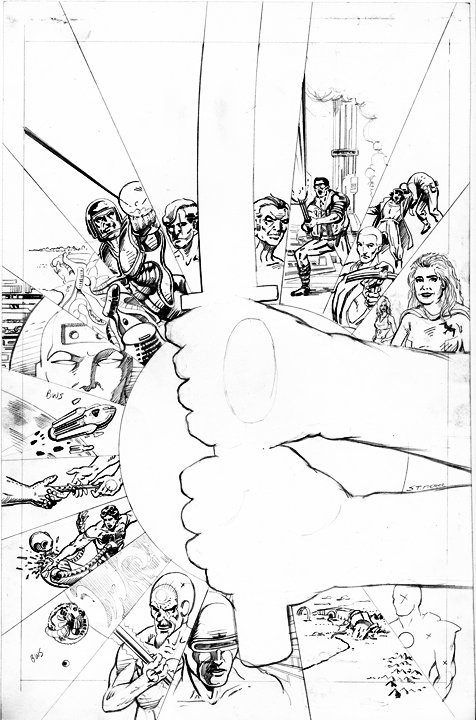
They look the same, don't they? That's because they are. However, look closely and you'll notice that there are not two copies of that image in the Tumblr photo. The one underneath is slightly different. In that one you can see the white of a hand and the blood splatter sword. Did David Aja draw a reveal to go along with the Rai #0 homage silhouette? Tres interesting no?

So who is leaking these photos?
  • A freelancer who occasionally visits the Valiant offices? 
No, the posts are too consistent and look to be shot after hours (see the night sky in the photos with windows?)
  • How about an overly excited intern? 
Possibly, but then why haven't they been taken down now that the Tumblr has been exposed?
  • Valiant Comics themselves?
Also, possible. If it is them then this is very cutting edge tech they are using (they've already showed that they are more than adept with Twitter and Facebook, racking up thousands of followers without any real announcements or images). I can't recall another comic book publisher that uses Tumblr. I hope it is Valiant and I hope they keep using cutting edge resources like this.

UPDATE: An eagle eye'd reader pointed out that the Tumblr's name, Man Of War, is clearly a link to the Valiant character, X-O Manowar. Don't know how I missed that!

Tuesday, October 18, 2011

Valiant Comics returns in 2012!

For my first update in quite a while I give you the best news you've heard since you were told about All Things Valiant: Valiant Comics will return to publishing comic books in 2012!

Now we don't know exactly when, which titles (though we can guess) or with which creative teams but we do know that a formidable team of executives have come together to make this happen - Peter Cuneo (former Marvel CEO and Vice Chairman), Fred Pierce (former Wizard Entertainment President), Warren Simons (critically acclaimed former Marvel Editor) and co founders Gavin Cuneo, Jason Kothari and Dinesh Shamdasani. Check out the press releases here and here. As well as the homage to Rai #0 that accompanied the release:


Now for several years we've been hearing rumblings of work being done behind the scenes and the founders wanting to take their time and bring Valiant Comics back to publishing in the strongest fashion and give it the best chance of sticking around. We've heard that Bill Jemas (former Marvel Vice President), Jim Shooter (former Marvel & Valiant Editor-in-Chief), Jeff Gomez and Bob Layton were all involved at various times. I don't like to post rumors, press releases or management announcements and avoided those updates but this, this is too exciting! The greatest universe of comic book characters to hit the stands in 40 years is now on its way back and we fans have cause to believe that its coming back with enough talent to set off the second Valiant big bang!!

Just check out these quotes:

We have been planning the reintroduction of the Valiant titles for some time and I’m excited to announce our scheduled launch for 2012” said Dinesh Shamdasani. “Cutting-edge characters and stories were the core tenets of the original Valiant and are the core tenets of the new Valiant.

Valiant owns and controls a universe of some of the most recognizable characters in the comic world” added Peter Cuneo. “To this day, despite interruptions in its history, Valiant has retained an extremely passionate fan base. We are keenly focused on bringing the original Valiant Universe back for these fans as well as introducing these powerful characters and stories to new readers.

And to top it all off we have a hint of the potential caliber of artists and writers that will help bring us new Valiant Comics in the above image by none other than superstar artist David Aja (who just happened to have been the artist on the seminal and very acclaimed Immortal Iron Fist with a certain editor named Warren Simons).

Bring me back to the Valiant Era baby!!

Thursday, January 27, 2011

Rai #0: The Rejected Version

UPDATE - Full write through.


Rai #0 is one of the most important, most talked about, most exciting Valiant books.

It is the "Bridge to the Future" of the Valiant Universe, depicting major events from the present through to the creation of the last Rai in the 42nd century. It showed us the ultimate fates of a number of key characters such as Toyo Harada, Aric of Dacia and Obadiah Archer. It was named one of the Most Important Comic Books of the 1990s and one of the 20 Coolest Comic Covers. There has been controversy over it's famous cover being a swipe and potential lost pages and expanded editions.

Now, I've got a new twist to present and this one is a revelation. It turns out that the original illustrator for Rai #0 was not David Lapham but instead Rai series illustrator Joe St. Pierre, and that he and Jim Shooter completed a cover and seven pages of interiors in June of 1992 (Rai #0 was eventually published in November of 1992) for a vastly different version. Jim Shooter than rewrote the script from scratch which Joe St. Pierre did at least one page of pencils for before the book was assigned to David Lapham. Very few knew this tale and even fewer had seen the unfinished pencil pages, until they turned up on eBay today thanks to the authorized dealer for Joe St. Pierre art. Below you can see the original cover, pages 1 through 7 with accompanying story notes from the eBay auctions, and page 1 of the rewritten and published script by Joe St. Pierre.

Cover


Page 1

Page depicts a scene from the near future, when the HARBINGER WARS are in full swing. The daughter of FLAMINGO and ARCHER (from Archer and Armstrong) is being attacked by the enemy!

Page 2

Page depicts a scene from the near future, when the HARBINGER WARS are in full swing. The daughter of FLAMINGO and ARCHER (from Archer and Armstrong) uses her flame/heat powers to destroy an enemy tank. That's the Geomancer, now a dying wizard, in the last panel.

Page 3

Page depicts a scene from a near future, when the HARBINGER WARS are in full swing. The daughter of FLAMINGO and ARCHER (from Archer and Armstrong) meets secretly with the GEOMANCER. Thruout history. the Geomancer was protected by a Harbinger like Gilad the ETERNAL WARRIOR. This alternate future, an apocalyptic hell on earth, is so dangerous that now the Geomancer him/herself must be gifted with Harbinger abilities in order to survive.

Page 4

Page depicts a scene from a near future, where an ancient ritual is enacted: the daughter of FLAMINGO and ARCHER (from Archer and Armstrong) becomes the world's first HARBINGER-GEOMANCER. Thruout history, the Geomancer was protected by a Harbinger like Gilad the ETERNAL WARRIOR. This alternate future, an apocalyptic hell on earth, is so dangerous that now the Geomancer him/herself must be gifted with Harbinger abilities in order to survive.

Page 5

Page depicts a scene from a near future, where an ancient ritual has been enacted: the daughter of FLAMINGO and ARCHER (from Archer and Armstrong) has become the Earth's first HARBINGER-GEOMANCER. Thruout history, the Geomancer was protected by a Harbinger like Gilad the ETERNAL WARRIOR. This alternate future, an apocalyptic hell on earth, is so dangerous that now the Geomancer him/herself must be gifted with Harbinger abilities in order to survive. The last panel depicts an assault on Orb industries by a Harbinger battalion.

Page 6

Page depicts a scene from an apocalyptic future, where the HARBINGER WARS are in full swing. An aging X-O MANOWAR stages the last stand for humanity against an army of Toyo Harada's Harbinger warriors.

Page 7


Page 1 from the published script by Joe St. Pierre

This page features Geoff and Bloodshot, though Bloodshot is chained onto his bed unlike the published version.

The Valiant marketing annual given to retailers at the Capital City Distributors conference explaining Valiant's upcoming releases and promotions provides more information and further proof about the rejected Rai #0 story. Check out an excerpt below:


From the excerpt we can see that Joe St. Pierre was indeed scheduled to illustrate Rai #0. This is in keeping with several other #0 issues in which the titles regular artist also drew the #0 issue. We also see that the story was originally going to explain the origin of the Rai Power and show us the creation of the first Rai. Very little has been published about either. What we do know is that the Rai Power was created by Grandmother when she felt the Blood of Heroes was a threat to herself, is incredibly powerful and can harm energy beings like Mothergod.

Monday, January 10, 2011

Photoshop Fun - Solar #10 white variant

Three posts in a row related to the color white! Solar, Man of the Atom #10 is a seminal issue in Valiant comics history. It was the first Valiant book to really break out and gain the attention of the masses. The all black cover was striking and perfectly apt considering the story (no spoilers here, I'm saving that for a post all its own), the first appearances of the Eternal Warrior and the Geomancers made the issue a back market collectors item (it reached prices well over $100), and it was the first Valiant comic to have a second printing published. Valiant very successfully marketed gold, platinum and even red editions of its comics to collectors but for some reason there has always been a rumor that a white edition exists of Solar, Man of the Atom #10. Let me clear this up now...IT DOES NOT! This rumor may have to do with the mystic surrounding Valiant in its early days. The company succesfully used hidden first appearances of its new characters to create a back issue feeding frenzy, had very low print runs when it was just getting started leading many readers to not be entirely clear what existed (See the Rai #0 glossy edition), was famed for creating and marketing additional material that was available through unique channels (Harbinger #0, Magnus Robot Fighter #0, UNITY #0), and was simply just a company that was doing some many new and exciting things that people didn't know what to expect them to do next.

All is not lost though, despite the fact that a white edition of Solar, Man of the Atom #10 does not exist we can marvel at what it would have looked like via the wonder of Photoshop:


This image is guaranteed to be sent around the internet without the accompanying text from this post and eventually provide 'proof' to those that insist a white edition exists. To try and avoid this I have attempted to name the file appropriately!

UPDATE: Looks like I'm not the only one with Photoshop:

Tuesday, November 9, 2010

Trivia - Expanded Rai #0 was planned?

I've only done one trivia post (BWS on Shadowman #10) in the past and now its time for another. Did you know ... that the Rai Trade Paperback was originally going to come polybagged with a special expanded edition of Rai #0?! According to a section in the Valiant Special Edition of Comic Shop News called "Valiant's Vision for the Future" it was. Check out the scan below:


Ultimately, the Trade Paperback printed Rai #0 as published within the book and came polybagged with the Rai Companion...no where near as cool.

Tuesday, September 7, 2010

Ads - Rai #0

I'm continuing my lazy posts with yet another scan of a Valiant advertisement.  This one comes from the 1992 Valiant Marketing booklet that was handed out to retailers. To get them excited for Rai #0 (arguably the greatest single issue Valiant has published to date) they published the following print ad.

Pretty cool huh? The Bridge to the Future! But why? Because Rai #0, unlike most of the other zero issue Valiant books which feature origin stories, is a bible or road map for a number of major events in Valiant's future. From first appearances to deaths, Rai #0 give the reader snippets of what was to come. Talk about ballzy writing! Also, there's that silhouette again.

Wednesday, August 25, 2010

Rai #0 cover silhouette a swipe?

Following on from the last post, did you know that the silhouette on the cover of Rai #0 is actually a swipe?


The cover shows the silhouette of Bloodshot (whose blood is part of the origin of the Rai lineage) and is drawn by artist David Lapham. But the concept was first sketched out by writer Jim Shooter. Shooter didn't have enough faith in his illustrating skills so he grabbed a copy of the Official Handbook of the Marvel Universe Deluxe Edition #10 (1986). and traced a Mike Zeck drawn image of Punisher! Lapham kept the look and the cover of Rai #0 ended up being a swipe. Don't believe me? See for yourself.

Here is the Punisher image in question.


And here is a silhouette created from said Punisher image.


Now here is a side by side comparison of the Rai #0 cover as printed and the cover with the Punisher image overlapping


Credit to both ValiantFans.com and ComicBrowser.com for the images.

UPDATE: Here is a direct quote from an interview with Jim Shooter explaining the swipe.

I actually drew the cover to Rai #0. It was just a silhouette, so someone had to fill it in and ink the dot. We had obviously planned the look of the character by that point. And I should admit this, in the interest of fairness: I was looking at a drawing that Mike Zeck did. I mean, I'm not that good an artist and the only reason I did it was that we didn't have anybody with a free pair of hands who could do it. If we'd had a real artist available, somebody else could have done it, but I ended up doing this because it was a silhouette. I figured, You know, I could do this. So I did just to save time for Bob and for Don and the other guys. I don' t think anybody could tell it was done by an amateur.

The Top 20 Coolest Comic Covers by CoverBrowser.com

Found this interesting list of the "Top 20 Coolest Comic Covers" of all time over at CoverBrowser.com and guess what the #1 coolest cover is?

Rai #0

Yes! Rai #0. What a great cover! So simple yet it says so much. The cover is arguably the first appearance of Bloodshot who was a heavily anticipated character. The use of a silhouette only fueled that anticipation. And the Japanese flag as a design element as well as the bleed through background for the red dot on Bloodshot's chest is beautiful.

Check out the list for yourself to see what else made the grade:

Friday, July 9, 2010

Page 1 - Rai #0

Once again I'm starting a new series. One of the things I love about Valiant comics is the visual storytelling. A lot of Valiant books will start with splash page (a full page of art instead of a series of panels). These are called page one splashes. I love them because they are so encompassing that it doesn't matter what is going on in your life, once you open the comic to that page one splash you are drawn into the story. I'm going to spotlight my favorites in this series and we're going to start with the one from Rai #0 (why not start with one of the very best!).


It beautifully drawn page by David Lapham features the first appearance of Bloodshot. How can you not be interested in the story once you see this page. You have to think what is happening to that man? Why is there a red circle on his chest? And why is there a kid in this high tech facility?

Tuesday, July 6, 2010

The ten most important comic books of the 1990s

Interesting article below which I have permission to reprint in its entirety.

The ten most important comic books of the 1990s

The 1990s was an incredible decade for comics. More people were buying and reading them than ever before and, in turn, more new publishers and new titles came into being. We had the formation of the superstar independent in Image Comics and the birth of the still unequaled VALIANT Universe, a high water mark in storytelling, as well as a host of others trying to imitate the two. Gimmick covers and variants were all the rage, but we loved them and (don't tell Marvel) we still do. We were all going to be rich because the generic hot book of the week was going to be the next big thing. Well hindsight is 20/20 and with that in mind, let's chart the Ten Most Important Comic Books of the 1990s. 


Number 10 - Authority #1
 
Authority #1 is very similar to the number one book on this list. Both books changed the way superhero teams are written, they both caused a storm when they were released, and they both brought a modern reality to comics. So, why isn't this book Number 1? Well, while the impact of the Authority in all three aspects is not as great as the Number 1 book, there is also one additional and very telling difference. In re-creating Stormwatch for the Authority, Warren Ellis fashioned characters who took matters into their own hands, cutting through the politics dealt with by the JLA and the Avengers. Both of those books, and a host of others, have adopted this approach since Ellis pioneered it, but that's where the innovation ends. The Authority is a really fun comic book that looks and feels like a blockbuster movie -- something enjoyable like Bad Boys 2 -- but not a piece of art, and certainly, not a masterpiece. Nevertheless, the innovations in illustrations and writing, and the subsequent influence on similar books, make Authority #1 a worthy entry at 


Number 9 - Daredevil #1
 
Produced under the Marvel Knights banner, Daredevil #1 was a harbinger of things to come. Joe Quesada proved he had the skills required to innovate the production process, reimagine an ailing icon, and still keep fans happy. Daredevil #1 was a key moment on his journey to the top of Marvel's creative mountain and a forerunner for the Ultimate line. But, even more important, is the other half of the book's creative team. Long time comic book fan and successful filmmaker, Kevin Smith, blazed a trail for writers from outside the medium. Before Joss Whedon, Bryan Singer, Brad Meltzer and Orson Scott Card could make waves, Kevin Smith had to prove that fans would accept an outsider. Smith was also crucial to the formation of Hollywood's current love affair with comics. He showed studios and the world that comics were cool, both through his work writing the book, and in associating himself with the medium.


Number 8 - Solar #0

The best single issue of the decade and number four on Wizard's list of the top ten best comics over the last fifteen years. Jim Shooter, Barry Windsor-Smith and Bob Layton, all at the peak of their powers, tell the story of the birth and death, and then birth again of the VALIANT universe. Originally serialized in the first ten issues of Solar Man of the Atom, the story set the tone for every science fiction and superpowered book that has come since. Shooter used real science, and even explained complex ideas, to firmly ground his epic. But, the real genius of the book is its focus on one man, Phil Seleski, and his struggle to come to terms with waking up to find he has the power of a god. Barry Windsor-Smith provides his best work since the final issue of his Conan run, while Jim Shooter only had to wait six months to top this (but we'll get to that).


Number 7 - Astro City #1

In Astro City, Kurk Busiek created a series based on good writing and accessibility. It sparked a trend in which collectors started reading Image books for the first time and, more importantly, brought a new audience into comics. Astro City made fans of those who had never, and probably would never, have read a comic otherwise. Core titles such as Spider-man, X-Men and Superman have a steep learning curve for new readers due to their lengthy histories and the inaccessibility of the comic book medium. In Astro City, each issue is a new beginning and is presented without many of the visual and narrative shortcuts that are conventions of the comic book medium but confusing for many first-time comic readers. 


Number 6 - Magnus #1

The first superhero book published by VALIANT Comics marks the birth of the only publisher to have ever seriously given Marvel and DC a run for their money. VALIANT did what Image was supposed to do: Create a roster of completely original characters under a shared universe, and they succeeded with both style and swagger. VALIANT came out of the gate with a winning formula -- a top quality product with great storytelling. The VALIANT name soon became associated with quality and everything they did turned out golden. VALIANT was the Gucci of the comics industry. 

Jim Shooter began the famous Steel Nation story line in Magnus #1 and it ranks among the best of all time (#17 according to Wizard's Top 100 Trade paperbacks). Magnus #1 would have placed higher but it only set in motion what would eventually spark a revolution. 


Number 5 - Marvels #1

Marvel gave this mini-series the royal treatment with high quality paper and a transparent acetate cover, but the real quality was from the creative team. Following the approach pioneered by VALIANT Comics, Kurk Busiek chronicled the beginnings of the Marvel universe in a distinctly real setting. We see the first Marvel heroes interact with a world that isn't used to superpowers or heroism. More interestingly, and probably more importantly, this book was fully painted by (and marks the break-out of) Alex Ross. Ross has since gone on to define comics for a generation of readers and creators with his vividly realistic paintings. Like the greats before him (Kirby, Steranko, Miller, etc.), Ross has since become a public figure and a respected artist throughout the world -- but it all started right here. 


Number 4 - X-Men #1
 
Marvel found a winning formula with Spider-Man #1 and repeated it less than a year later, but this time they pulled out all the stops. They united one of the hottest artists in the field, Jim Lee, with one of the hottest properties, the X-Men, in a new series with five different covers on the first issue. The comic had one of the biggest marketing campaigns in comics history: Marvel was aiming to break records, and break records they did. X-Men #1 still stands as the highest print-ordered comic in history with more than eight million copies in all versions.

Among collectors, the pairing of Lee and the X-Men further established the mental association of a big talent on a popular book equaling a good product, which led to a string of new short-lived titles with big-name creators. More importantly, it proved the power of the industry's superstar artists and set the stage for their eventual departure and the formation of Image Comics.


Number 3 - Superman #75
 
As the story goes, the day Superman #75 hit the stands there were lines outside comic shops across the country. The Death of Superman was a major news story that was covered by the likes of CNN and Time magazine. It was the death of an icon -- probably the most famous character in all of comicdom. In hindsight, it was nothing more than a publicity stunt by DC, but it worked spectacularly. Superman #75 had one of the largest audiences in comics' history, and in turn, one of the largest print runs. Suddenly everybody was collecting comics and the hobby was flooded with speculators. Sports card dealers (who had just suffered a huge crash in their own market) shifted their attention to comics, creating a vast new audience. The entire industry benefited, but at a great cost: Event books and gimmicks were all the rage, and The Death of Superman was soon followed by major changes to almost every character conceivable -- most memorably Batman, Green Lantern and Daredevil. The flashy covers and excessive hype got old quickly and much of the new audience moved onto the next hottest craze, sending the industry into a low it's still struggling to overcome. Eventually, Superman did return, but Superman #75 still stands as a unique moment in the decade - when the eyes of the world were focused on comic books, a feat not repeated until the opening weekend of the first Spider-Man movie.


Number 2 - Spawn #1
 
At the height of his popularity, Todd McFarlane left Marvel and Spider-Man behind to create his own character. Spawn's inaugural issue was one of the top selling comics in history, and unlike a number of other Image creations, has stood the test of time -- the book just reached its 150th issue. But, McFarlane did more than create a hit book with Spawn. Spawn #1 is the book that built an empire. MacFarlane has since added to his publishing wing by forming a major toy company built on the Spawn characters and a multimedia division that has produced a Spawn animated series and a movie.

Often recognized as one of the most important characters created since Stan Lee and Jack Kirby created the Marvel icons, Spawn might have nabbed the number one spot on this list had the character been a more exceptional creation. But the book's writing was never a big part of its success. As part of the first wave of books released under the Image Comics banner, Spawn #1 is a marker of an event that changed the face of the comics industry. Image comics is the creator-owned start-up founded by the seven, now famous and, in some cases infamous, superstar artists of the comics world. Image was supposed to break up the monopoly of Marvel and DC, and for a while it looked like it might. Today, Image continues to provide creators with an alternative publishing route for their properties and remains a symbol of independence for the industry.


And the comic book of the decade is...


Number 1 - Harbinger #1 
 
In the editorial, VALIANT's Editor in Chief, Jim Shooter, tells us that the book we hold in our hands is the most important since Avengers #1. Thirteen years later and I'm still not sure that he was wrong. When this book was first released it was a national sensation. Every kid worth his polybag and backing board just had to have one, and the resulting frenzy sent the book to the top of Wizard's Top Ten Hottest Books List for a then-record four months. What's more, the demand didn't stop even when the book began selling for well over $100. When it was good, Harbinger was without a doubt one of the best written books in comics history. The first story line ( Children of the Eighth Day) deserves to be uttered in the same breath as the masterpieces of the art form; Watchmen, Maus, Dark Knight Returns, etc.. 

 
The book's creative team reinvented the genre popularized by the X-Men. The good guys did unforgivable things, the bad guys were usually more right then the good guys, and best of all, they behaved like real people would -- In the VALIANT Universe, when you want to kill your enemy, you don't challenge him to a stand-off at your base on the moon (this is actually a plot involving the X-Men), you send someone he trusts to shoot him in the back of the head. Things happen in Harbinger that would never happen in an X-Men book (for those that know Harbinger think Torque), but happen all the time in the movies and other arts, and definitely in real life. Most importantly, Harbinger was the book that sparked a revolution in comics. Harbinger was the Pulp Fiction of the comics industry -- an indie critical and commercial smash hit that changed all the rules and broke down the door for a host of independent talent. Without Harbinger, VALIANT wouldn't have become the third largest publisher as quickly as it did. Without Harbinger, there wouldn't have been an Ultraverse Universe or a Crossgen Universe. Without Harbinger, there wouldn't have been a wake-up call for the rest of the industry to move away from gimmicks and hype, and back to quality story-telling.
 
Twenty more that almost made the list:


Adventures of Superman #500 (DC) - The sequel to Superman #75 with equally high orders, the book's poor quality left a bad taste in readers mouths' and set the ball rolling that would crash the industry.

Bloodshot #1 (VALIANT) - The day Death of Superman hit the stands there wasn't one line outside comic shops across the country, there were two -- one for Superman and one for Bloodshot.
Bone #1 - The biggest consistently successful independent book and the second independent book to achieve success after Cerebus.
Dark Horse Presents 5th Anniversary Special (Dark Horse) - The first appearance of Sin City. Miller's creation has shown outsiders that comics are more than superheroes.


Death, the High Cost of Living #1 (Vertigo) - The first book published under the Vertigo Comics banner.
Gen 13 #1 (Image) - The second hoorah of the bad girl craze and the beginning of a new slate of successful Image books.
Harbinger #0 Pink Cover (VALIANT) - The most sought-after variant of the decade and the hardest book to find from the most sought-after story-line of the decade.
Kingdom Come #1 (DC) - Cemented Alex Ross as the artist of the decade and pushed the back-to-basics writing approach into overdrive.
Lady Death #1 (Chaos) - The start of the Bad Girl craze. Although predated by the Vamperilla mini-series, the success of Lady Death came first.


 New Mutants #87 (Marvel) - The first appearance of Cable, a major X-Men character and one of the most sought-after books of the decade.
Next Men #21 (Image) - The first appearance of Hellboy. A fan favorite, critical darling and blockbuster movie star.
Preacher #1 (Vertigo) - The most popular book from the Vertigo line. Preacher made writer Garth Ennis and his writing style famous.
Prime #1 (Ultraverse) - From the success of Image comics, Malibu formed Ultraverse and spent millions on marketing. Prime #1 was the flagship title and ultimately led to the computer coloring revolution.


Rai #0 (VALIANT) - Innovations galore (enough for its own article), the bible of the VALIANT universe and possibly the best cover of the decade. This was one of the most sought-after books from Rai, one of the most famous characters of the decade, and a strong contender for the ten most important comic books of the decade.
Spider-Man #1 (Marvel) - Paired together Todd McFarlane and Spider-Man, broke a number of sales records, and set the stage for Image comics.

Turok #1 (VALIANT) - One of the top ten largest print runs in history, a runaway video game success that brought gamers into the fold, and the first real sign that comic properties were viable for licensing.
Unity #0 (VALIANT) - The first chapter in one of the greatest company-wide crossovers in history.


Witchblade #1 (Top Cow) - The flagship and most successful book by Top Cow. Has since become a television series, animated series and is gearing up for a feature film.
X-O Manowar #1 (VALIANT) - X-O Manowar is one of the most popular characters created in the past 15 years and issue #1 is his first appearance.
Youngblood #1 (Image) - The first book published under the Image Comics banner.

Saturday, July 3, 2010

Rai #0 skateboard

Check out this 1993 ad from Planet Earth where they showcase a number of custom board graphics. The most prominent one featured here is a limited run of decks featuring the cover of Rai #0 for the price of  $41.95. Sweet.


Thursday, May 27, 2010

Comic Cavalcade 1993 Valiant Catalog

Back in 1993, when the speculator market was at its height, I mailed away for the Comic Cavalcade back issue catalog. Now back then these guys, along with Kingpin Comics, were the back issue experts (it even says so right on the catalog!). I recently found that I still had the catalog and was interested to see the kinds of prices key Valiant books were bringing. Below is a scan of the Valiant section of the catalog (click to enlarge).


Now, 1993 was smack dab in the middle of the Valiant Era. Had Acclaim not come along and revamped all the great Valiant characters for video games a few years later, I think Valiant had a real shot at becoming the third major universe along with Marvel and DC for good. In 1993, everyone was looking at Valiant and seeing similarities to what Marvel had done in the 1960s. Valiant had the same quality of storytelling, uniqueness of characters and strength of fan excitement. It made sense then to believe that the key Valiant books would in time be as valuable and and sought after as the key Marvel books had become. They certainly were and still are the most valuable and sought after new books created in the 1990s.

Let's take a look at some interesting specifics.
  • All the gold books are priced at around $75-$100+
  • Eternal Warrior #1 gold flat is the most expensive one at $125
  • The Deathmate golds are the cheapest at $40 each
  • Armorines #0 gold is split into gold flat and gold foil. The foil being more expensive. I am not aware of two versions of Armorines #0 gold
  • The first issue of Eternal Warrior and of Archer & Armstrong are $12. This despite the higher print runs they have compared to the first issues of other characters that debuted earlier. Goes to show just how popular the immortal brothers were
  • Eternal Warrior #4 (the joint first appearance of Bloodshot along with Rai #0) is $30
  • Eternal Warrior #5 & #6 (the two part Barry Windsor-Smith story) are $15 a piece!
  • Harbinger #0 send away (pink variant) is priced at $175 and #1 is $160!!
  • Even the later Harbinger issues are crazy expensive. #2-5 are $75 each, #10 (first H.A.R.D. Corps) is $20, #7, 11 and 14 (random issues) are $15 which is more than the first issues of Eternal Warrior or Archer & Armstrong. Hell even the limited blue TPB is $65!
  • Magnus Robot Fighter #1 without card is cheaper than I would have expected at $75. #12 (first apperance of Turok) is $100 though
  • There is a Ninjak chromium card listed at $35
  • Rai is pricey. #0 is the same price as #1 ($40) and the famously rare #3 & 4 are $80 each
  • Shadowman #1 is $50
  • Solar: Man of the Atom is cheaper than expected. Solar #1 (the first ever Valiant book) runs $35 (less than first issues of X-O Manowar, Shadowman, Harbinger and Magnus Robot Fighter)
  • Solar: Man of the Atom (first appearance of Eternal Warrior) is $80 though
  • Turok was worthless even in 1993
  • UNITY #0 red variant is $150. And there is a signed by all (drool...) variant for $200.
  • X-O Manowar #4 (first appearance of Shadowman) is $45 and #14 (Bart Sears art) is $10
  • There is a Ninjak #1 VVSS?
  • Bloodshot #6 is listed as a VVSS not as a seperate Valiant signed project.
  • Overall the prices are about right for 1993, maybe even a tad cheaper than expected.
Did I miss anything interesting?

Monday, May 24, 2010

Unpublished - Rai #0 panels

I found these very interesting unpublished panels from Rai #0 at comicartfans.com. Its quite a treat to see unpublished moments from the early Valiant books, especially from a book as important as Rai #0.


Rai #0 was billed as Valiant's bible to the future. It contains an overview of the major events in the Valiant universe from the present through to the creation of the last Rai in the 42nd century. Rai #0 also includes the ultimate fates of a number of key characters such as Toyo Harada, Aric of Dacia and Obadiah Archer. The story telling is incredibly clever - all the moments shown are brief and told from within a specific context and perspective. Events may be drastically different when told later from a more objective context even though the event itself doesn't change. For instance, we see a memorial for Shadowman, however, we can't truly believe that he is dead since his death is not depicted, his body is not visible and few details are given.

These two panels do not come with accompanying script but we can quickly recognize a few major characters. Specifically, Sting (of Harbinger) and Archer. There are also three unidentifiable women in the panels. The woman in panel one, immediately to Archer's right may potentially be Flamingo (Rai #0 as published explained that they were eventually married). The second women in panel one could be Kris. All the characters look similar in age here to how we know them so we can assume this takes place near present day. Could this be how the Harbinger kids form a relationship with Archer?

Additionally, we can gleam from the art a sense of placement and story by looking at the words written around the art. Above the second panel we see that the panels would have appeared on "page 9" of Rai #0. Below are pages 8 and 9 of Rai #0 as printed.


These pages deal with Archer and Flamingo in present day and in contempary settings. The unpublished panels seem to take place in a more futuristic or scientific setting and do not seem to fit within the panels printed. Can they be an alternate story point or possibly a additional story point that was cut for space or even because it would give away too much of a future storyline.

We also see above the second panel the words "Thelma kills" and then some words that I can't make out. Archer's mother is named Thelma and did try to kill him but I don't think that's what is being discussed here. I have no idea who the women in the second panel is but she is definitely not Thelma Archer. If anyone has any more information please share.